
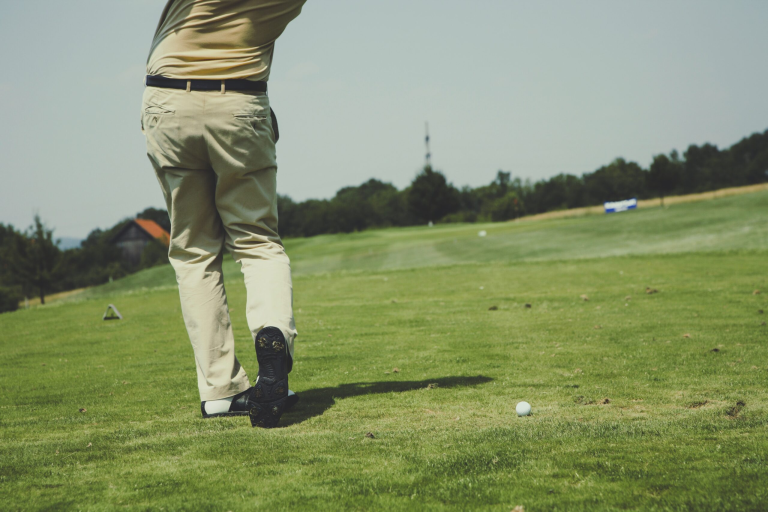
Changes in club weight, length, and balance point (swing weight/MOI) primarily alter the club’s inertial load and “feel.” These mechanical shifts drive adaptations in muscle recruitment, tempo, and timing. The autonomic nervous system (ANS) modulates the outcome indirectly: a well-matched club supports a calmer, more parasympathetic state with lower unnecessary tension; a mismatch raises perceived effort or instability, elevating sympathetic arousal (tighter grip, co-contraction, rushed or protective movements). Together they affect the four metrics as follows.
Swing Speed (Clubhead Speed)
Higher total mass, higher head weight, or higher swing weight/MOI generally reduces clubhead speed for a given effort. Controlled studies show drops of roughly 0.5–3 mph (sometimes more) as head weight or swing weight rises significantly, because greater inertia slows angular acceleration.
Lighter shafts or lower overall MOI often allow higher peak speeds (roughly 1–2 mph per meaningful shaft-weight reduction in many cases). Longer clubs can increase speed via a larger arc if the player can still accelerate them, but excess length or weight frequently offsets this through slower rotation or early release.
ANS contribution: Excess tension from a heavy or poorly balanced club shortens the swing or reduces free acceleration, further limiting speed. A properly fitted lighter or better-balanced club reduces gripping effort and supports fuller, freer acceleration.
Face Angle at Impact
Heavier heads or higher swing weights tend to leave the face more open at impact. One study with progressive head-weight increases moved average face angle from slightly closed to about +1.6° open.
Lighter configurations often make it easier to square or close the face. Counterbalancing (shifting the balance point toward the hands) can improve head awareness and release timing, helping face control.
ANS contribution: Sympathetic-driven grip pressure spikes make face rotation less consistent—tighter hands can delay release (more open face) or produce jerky closures. Lower tension from a well-matched club improves fine motor control of the wrists and forearms, stabilizing face angle.
Swing Path
Increased head weight or swing weight frequently alters path. Common observations include the club “staying behind” longer (potentially more in-to-out) or compensatory early casting that steepens or shifts the path leftward (more out-to-in). Individual responses vary; some players swing more left, others more right, with path changes of 1–2° (occasionally larger) reported.
Length changes the swing plane and path: longer clubs raise the plane and can exaggerate existing path tendencies if control is lost. Total weight (especially shaft weight) can be used intentionally in fitting to neutralize an outside-in path.
ANS contribution: Protective co-contraction or rushed tempo under elevated sympathetic tone encourages over-the-top moves or early hand action, amplifying path errors. A club that feels stable and “set” at the top supports a smoother transition and more neutral path.
Consistency (Contact Quality, Dispersion, Repeatability)
Optimal matching of weight, length, and balance improves tempo, head awareness, and center-face contact. Moderate increases in swing weight sometimes raise smash factor and reduce extreme misses even if raw speed drops slightly, because the player better senses and times the head.
Too light: loss of head feel, rushed transitions, heel strikes, and wider dispersion.
Too heavy or too long: casting, fatigue over a round, open-face tendencies, and larger left-right or distance variance.
Proper length is especially critical for accuracy—excess length raises club MOI and loads the swing, making path and face control less repeatable.
ANS contribution: Mismatch increases baseline tension and makes the player more susceptible to pressure-induced breakdowns (grip spikes, shortened swings, frozen release). A well-fitted set keeps the nervous system closer to a calm, coordinated state, reducing shot-to-shot variability in path, face, and speed—particularly under on-course stress.
In practice, small, individualized adjustments (a few grams of head weight, half-inch length changes, or counterbalancing) produce the largest benefits when they restore natural tempo and head awareness. Launch-monitor data during fitting is the most reliable way to quantify the net effect on path, face-to-path, speed, and dispersion for a given player, because individual biomechanics and ANS responsiveness differ. The goal is a club that the body can accelerate freely without protective tension, delivering a more repeatable path and face at higher effective (not just peak) speed.
Changes in club weight, length, and balance point (swing weight/MOI) primarily alter the club’s inertial load and “feel.” These mechanical shifts drive adaptations in muscle recruitment, tempo, and timing. The autonomic nervous system (ANS) modulates the outcome indirectly: a well-matched club supports a calmer, more parasympathetic state with lower unnecessary tension; a mismatch raises perceived effort or instability, elevating sympathetic arousal (tighter grip, co-contraction, rushed or protective movements). Together they affect the four metrics as follows.